18 October 2026 - Canon Ric’s sermon
Loving God, may these words and the thoughts and meditations of all our hearts be favorable in your sight, now and always. Amen.
It is no great secret that the teachings of Jesus, especially those about the Kingdom of God and what God expects of those who are God’s chosen people, did not sit well with the religious authorities in Jerusalem at the time. Jesus was direct and unrestrained in his teachings and all too often what he said struck a very sensitive nerve with the Pharisees, the Sadducees, the Chief Priest, the Scribes, the elders of Israel and even, from time to time, the Herodian’s. Perhaps they felt their authority, power and position, religious as well as political, were being threatened. But it is not likely that Jesus said the things he did just to get under the skin of all the religio-political leaders of his time. Rather, Jesus simply and honestly spoke the truth of God and the Kingdom of God as he understood it and he did so based on his all-encompassing knowledge and understanding of scripture and his profound and abiding faith. Jesus saw deeply into the heart of God and he had the courage and conviction to speak the truth of the heart of God without reservation.
It should come as no surprise then that today we hear once again, as we have heard so many other times, that some of those leaders, in today’s Gospel it is the Pharisees, plotted to entrap Jesus in what he was saying. To execute their plan the Pharisees sent their disciples and some Herodian’s to confront Jesus. This was not the first time that the Pharisees and the Herodian's had conspired together; in the Gospel attributed to Mark (Mark 3:6), we hear that fairly early on in the ministry of Jesus, “the Pharisees went out and immediately conspired with the Herodian’s against him, how to destroy him”. The animosity we hear about in today’s Gospel passage was not new; it was long held, deep seated and unyielding.
It is very interesting that when the disciples of the Pharisees along with the Herodian’s approached Jesus with the intention of entrapping him, they began with what might be thought of as complimentary or flattering words: “Teacher,” they said, “we know that you are sincere, and teach the way of God in accordance with truth, and show deference to no one; for you do not regard people with partiality.” But then the tone changed. Then they asked a question that they believed would trap Jesus and lead to his downfall. They asked, “Is it lawful to pay taxes to the emperor, or not?” They were there to trap Jesus and they believed they had done just that for if Jesus said yes, he would anger the Jewish people who hated Roman rule and high taxes. If he said yes, the Jewish people would see him as a supporter of Rome and therefore not as the true Messiah. On the other hand, if Jesus said no, they could report him to the Roman governor as a dangerous rebel who opposed Caesar and that would most certainly lead to his quick arrest. Either way, Jesus would be undone. The annoyance and irritation would be over.
However, Jesus knew their intentions were malicious. He was not caught off guard by their false flattery and not swayed but their sugary sweet words of praise. Jesus knew they were not there to butter him up but rather to trip him up. As Jesus saw into the heart of God so too, he saw into the heart of those who hoped to silence him. Jesus was aware of their malice and would not be trapped by their question.
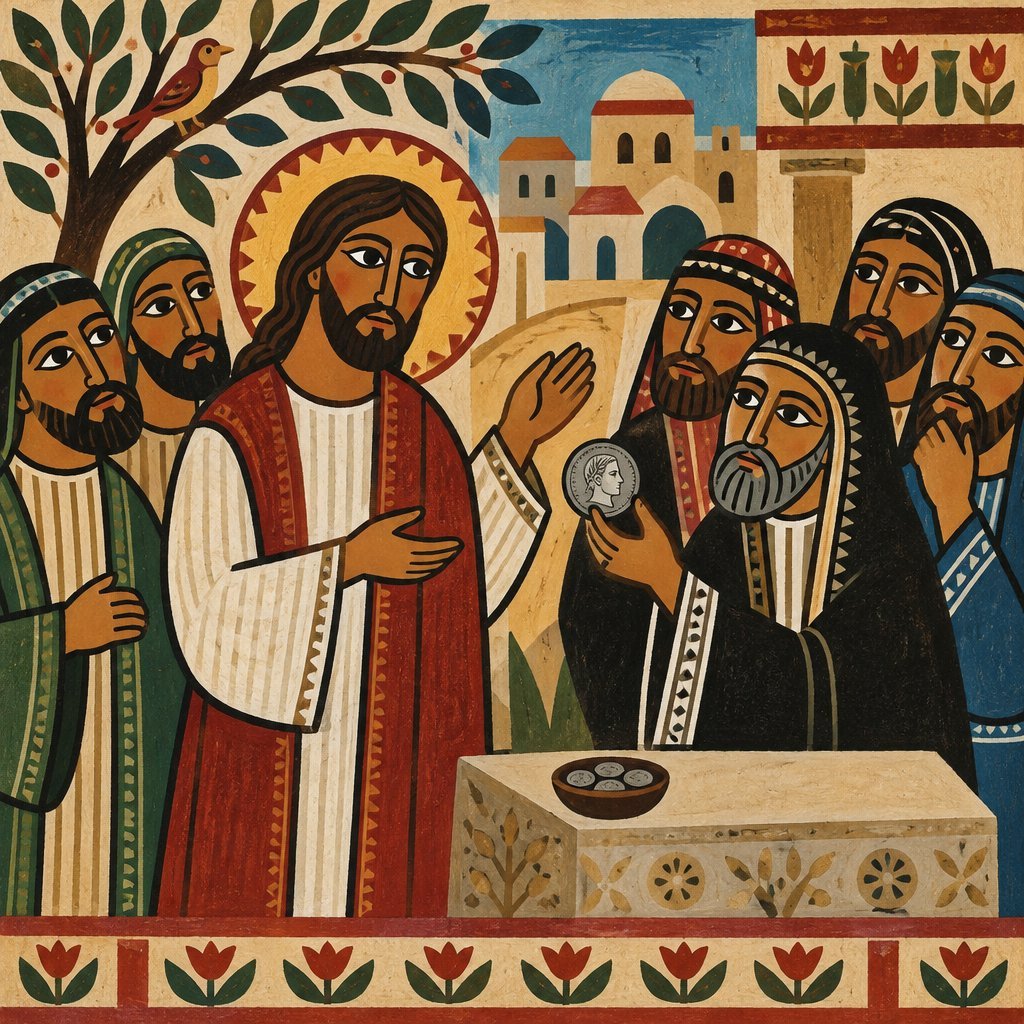
Jesus asked to see the coin that was used to pay taxes to the emperor. Though it wasn’t a fancy coin by any stretch of the imagination, it would have been seen to symbolize Roman imperial authority. On one side of the coin there was the image of the emperor, Augustus Caesar, with the inscription "Caesar Augustus Tiberius, son of the Divine Augustus". On the reverse side there was a seated female, usually identified as Livia, the wife of Caesar. On the coin Livia was depicted as Pax, or Peace in English. Pax was a Roman goddess who represented peace achieved and sustained through Roman power and victory.
“Is it lawful to pay taxes to the emperor, or not?” Jesus did not give a simple "yes" or "no" answer to their question. If he had done that he would have played right into the hands of the disciples of the Pharisees and the Herodian’s. Rather, in good rabbinical fashion, Jesus simply but most profoundly asked them a question in return. Pointing to the coin he asked them whose image and title were on the coin. They replied, “The emperor’s.” Then Jesus said to them, ‘Give therefore to the emperor the things that are the emperor’s, and to God the things that are God’s.’ The image of Caesar on the coin provided Jesus with all he needed to once again speak without hesitation or reservation about the truth of the Kingdom of God.
It never ceases to be amazing how Jesus could take an everyday object or real-life situation and use it to reveal the fullness of the reality of the Kingdom of God. Even the disciples of the Pharisees and the Herodian’s who had intended to trap Jesus were amazed - so amazed that they could not respond. His wise answer shocked and amazed his critics, leaving them with nothing to use against him; leaving them with only one option, the option to leave, to walk away.
In that moment, which is just one in a sequence of challenging encounters directed at Jesus by the religious leaders of his day, Jesus made a rather simple but astounding statement - give to God that which is God’s. That, of course, begs the question, “What is God’s?” What is it that we have that is God’s that we are to give to God?
There is an old joke about how various religious leaders divvied up the Sunday morning collection. One said that they drew a circle on the floor, threw the Sunday morning collection up in the air. What landed inside the circle was for God and what landed outside the circle was for the church. The second had a similar response except in their case, what fell inside the circle went to the church and what fell outside the circle was for God. The third said that they also drew a big circle on the ground and would throw the collection into the air just like the others. However, for the third, what landed inside the circle is for the church, what fell outside the circle is for the priest themself and what God wanted God could grab when they threw it up in the air.
Lest we get as far off-track as were the religious leaders in Jesus’ time, let’s get back to the point.
Jesus said, “Give therefore to the emperor the things that are the emperor’s, and to God the things that are God’s.” In that moment Jesus acknowledged that people do have duties to earthly governments, duties such as paying taxes with money that belongs to Caesar because it bears the image of Caesar. But in that moment Jesus affirmed that we have a higher duty, a duty to God, a duty that calls us to give to God that which is God’s. By asking whose image was on the coin Jesus was also challenging us to reconsider where we should expect to find God's image, he was calling us to look again and remember that we are all created in God's image and so we are to give our lives, our very selves, to God whose very image we all bear.
If we really think about it, if we, like Jesus, look deeply into the heart of God and if we truly believe the things we say we believe, we cannot help but realize just how amazing these words of Jesus really are. Perhaps you will recall the biblical quote in the Book of Common Prayer, words that are recited at the time of the offertory in the service of Holy Communion. They are words that come from chapter twenty-nine of 1 Chronicles in the Hebrew Bible; “Blessed be thou, Lord God of Israel, for ever and ever. All that is in the heaven and in the earth is thine. All things come of thee, and of thine own have we given thee.” (BCP pg. 74)
All that is in the heavens and all that is on the earth belongs to God’s, including and especially our very selves who are created in the image of God. As children of the one true God we are to give to God the things that are God’s which means not just all the things we have but more significantly, our very lives, all that we are, the totality of our beings - heart, soul, mind and body. In a word, what Jesus has told us we are to give to God is everything!
11 October 2026 - Canon Ric’s Thanksgiving Sermon
Let us pray. Loving God, in creation you breathed your Spirit into us and into this world. May your eternal truth always be in our hearts and may our hearts always be filled with thanksgiving. Amen.
Happy Thanksgiving to you all.
Today we have heard a wonderful and quite well-known story that is found only in the Gospel attributed to Luke. It is a story about an encounter between Jesus and a group of ostracized and marginalized people, ten people actually, shunned by normal society because they suffered some form of skin aliment. And because of their visible physical disease, those ten people were labeled as unclean and being unclean they were marginalized, forced to live on the fringes, the outer edges of society. They were shunned, unwelcome, outcast, reviled, scorned, maligned and even feared. Should they come near anyone who was not diseased they were to keep their distance and yell out a warning “Unclean, unclean!”
On one level, this is a story of restoration. From a distance the ten outcasts, referred to as lepers, called out to Jesus, “Master, have mercy!” “Master, help us!” It is interesting to note that the ten marginalized people called out together, they spoke with one voice; they were community, marginalized community yes but community nonetheless. Note also the movement of the story at this point: Jesus didn’t go to them, he said “Go!” to them - “Go, show yourselves to the priests.” There is good reason for that. Jesus sent the lepers to the priests to follow the Mosaic Law found in Leviticus 14, which required a priest to officially inspect and declare a healed person clean so they could return to normal life. And so Jesus sent them to the priests knowing that they would be made clean before they got to the priests.
And so it was. As the ten went, Luke tells us, the ten were indeed cleansed, they were made clean. The Greek translated as “made clean” implies nothing more than that they were cured of their disease and being free of disease meant they were no longer unclean. Cleansed simply means cured. Now, I don’t profess to understand miracle. In truth I am not certain miracles are meant to be understood, only received and so I won’t presume to try to explain the “how” of this moment. All I know is what the author of this Gospel tells us which is that when the ten lepers obeyed Jesus and went, the disease left them, they were made clean. That meant that once the priests saw them and declared them to be free of the disease, they would no longer be marginalized and would no longer need to live in the shadows of society.
After the healing of all ten lepers, the focus narrows to just one of the ten. We are not told anything more about the nine. My guess is that the first thing they did was exclaim, “Holy moly, what just happened!” Then, after they were declared clean by the priests, I imagine they head straight for home by the most direct route possible without even stopping at Tim Hortons. Freed from their afflictions, their marginalized community was shattered and they headed for the communities of family and friends from which they had been cast out!
Nine ex-lepers made a bee-line for home - but one turned back. Luke tells us that one of the ten was different, one of the ten realized that there was more going on than just the physical cleansing. Luke tells us that the one saw that they had not just been made clean, they had been “healed”. In Greek “healed” (iaomai) is a different word than the word for “cleansed” (katharizō). This one, the one who turned back, was not just made clean, this one was healed. This one realized the deeper and more profound reality of being physically free of disease - this one understood the emotional and spiritual reality of being not just cleansed but healed and in seeing this fullness and recognizing from whence the healing had come, this one, filled with praise to God, went searching for Jesus.
And when this one caught up to Jesus, he poured out his thankfulness at the feet of Jesus. And in that moment, that moment of praise and thanksgiving that ex-leper went from being made clean to being healed to being made whole. The ex-lepers faith brought about a new way of being. No wonder that one praised God with a loud voice and lay at the feet of Jesus, giving Jesus thanks.
We should note that the verb for “thanks” used in this passage is eucharisteō which is the same word used when Jesus gave thanks to God for the bread and cup at the last supper (Luke 22:17 & 19). It is the Greek word that is the basis for our word Eucharist.
This is our national Thanksgiving weekend and in this great land of ours there are all sorts of annual Thanksgiving traditions: many will get together with family and friends and there will be food and drink, laughter and good cheer. Perhaps some will take a moment to share what they are thankful for. Others might take a nice long leisurely walk or drive in the country to admire the beautiful autumn leaves. And the sports fans will hit the couch to watch a game of some sort on TV.
I wonder though, in what is an increasingly secular society, how many folks across this great country of ours will pause to give thanks to God, the source of all things, as did that one ex-leper so many years ago.
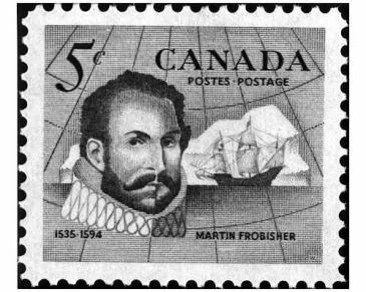
My father was a philatelist, a stamp collector and he got me into collecting stamps too, though quite modestly and only for a short while when I was young. Though it was quite some time ago, I vividly remember a 1963 Canadian five cent stamp commemorating explorer Sir Martin Frobisher’s 16th. Century voyages to the eastern Arctic in search of the Northwest Passage. At that time, I had no idea that that stamp had any relevance to our Canadian Thanksgiving.
Of course, we all know the United States story of the first Thanksgiving. In that story, the "First Thanksgiving" was a three-day long harvest celebration in the autumn of 1621 shared by the Plymouth colonists and about 90 people of the Wampanoag tribal nation in what is now present-day Massachusetts. It was not a religious "thanksgiving" service, but a secular harvest festival to celebrate the colonists' first successful crop after losing half their population the previous winter.
The Canadian version is a little different. As the story has it, in 1578, (that’s forty three years before the Plymouth colonists had their harvest thanksgiving meal) Frobisher’s third expedition to the Canadian Artic was perilous. It was in late August or early September that year, on Baffin Island, that the expedition’s chaplain, the Reverend Robert Wolfall, an Anglican priest by the way, celebrated a Communion service on ground that is now part of the Canadian territory of Nunavut. History records that Mr. Wolfall preached a godly sermon encouraging everyone on that expedition to be thankful to God, despite the ordeals and obstacles they had encountered.
Remembering that the Greek word eucharisteō, which means to give thanks or be thankful, is the basis for our word Eucharist, I should like to suggest that that particular Communion service celebrated by the Reverend Robert Wolfall, that holy meal that we call the Eucharist, was the first Canadian Thanksgiving Day celebrated with a simple meal of bread and wine - the body and blood of the Christ.
Once again we have exceptional cause and opportunity to give thanks to God; to give thanks that God has called each of us to this place to continue the rich heritage of this community of faith, to give thanks that God has called each of us to be the hands and heart of Jesus in our time; to give thanks for the opportunities that arise from the challenges we are facing at this moment in time; to give thanks for the future of God’s church as we faithfully move into the future into which God is calling us and as we faithfully lay down a solid foundation for those who will be called to this place in the years to come.
So this Thanksgiving Sunday morning, may we, in the same spirit as they did that first Canadian Thanksgiving on Baffin Island so many years ago, gather in hope and faith to celebrate the Holy Eucharist, giving thanks to God, who is and was and always shall be the source of all things.
Thanks be to God. Amen.
Gratitude is the acknowledgement that all we are and all we have is a gift from God. And because it is a gift, it is not ours to hoard or exploit, but to be respected and shared. As Toronto-based theologian and social justice activist Mary Jo Leddy puts it, gratitude “awakens the imagination to another way of being, to another kind of economy, the great economy of grace in which each person is of infinite value and worth.”
4 October 2026 - Canon Ric’s sermon
Gracious God, may only your truth be spoken and only your truth be heard. We ask this in the name of your Christ and our Lord, Jesus. Amen.
Jesus said, “Listen to another parable.” I doubt Jesus would have put that much emphasis on the word “another” but, there is no doubt, he did like to use parables, those special stories that turn the values and expectations of this world upside down, to get his message across.
Today’s parable, which in my favorite Bible is called The Parable of the Wicked Tenants, highlights a landowner who planted a vineyard, built a fence around it, even dug a wine press and erected a watchtower. It was quite the set up. He then leased the operation to tenants.
The plot is intense and at first blush I would have to say that the parable is not only unpleasant it is outright horrifying: it is filled with nasty bits that I have a great deal of difficulty thinking a gentle Jesus meek and mild would ever have conceived of let alone allowed to fall off his lip. This parable has greed, shameless dishonesty, extreme violence (even to the point of murder)and delusional thinking all of which lead to the chief priests and elders of the people, those whom Jesus was in dialogue with, to speculate there would be vengeful and violent retaliation. I can’t help but wonder how Jesus’ pronouncements about generosity, honesty, non-violence, being a neighbour, thinking as God would think and realizing that vengeance is in God’s hands not ours, can be harmonized with the tone of this parable.
On the surface, this is indeed one shocking parable but yet, it is a parable that is included in all three of the Synoptic Gospels. While the versions of this parable found in the Gospels attributed to Mark and Luke are a little less severe and vary in some of the details than the one in Matthew, all three culminate with the son of the landowner being killed and the prediction, on the part of the chief priests and elders of the people, that the landowner will kill the tenants, called wretches in Matthew’s version, then find other tenants to take the place of the wicked tenants, other tenants who will farm the vineyard and at harvest time, give the appropriate portion of the produce to the landowner.
Some folks see this parable as an allegory or extended metaphor, that is, a story in which each of the elements, whether a person, a thing or an event, has a hidden or symbolic meaning. In seeing this parable in this way, through an allegorical lens, the landowner is understood to be God, the vineyard represents the nation of Israel, the tenants are the people of Israel or possibly more specifically the religious leaders of Israel, the servants sent by the landowner are the prophets, the son of the landowner is, of course Jesus and the new tenants are most likely members of the group of Jesus followers known as The Way, the new Christian community or as we like to call it, the church, although some scholars find other meanings for the new tenants.
Proponents of an allegorical understanding assert that once we understand the code, the hidden meaning of the parable will become clear: God established a covenant with the people of Israel (planted a vineyard), God sent the prophets (the servants) whom the tenants (the religious authorities of Israel) killed, so God sent his Son (Jesus) whom the tenants (again, the religious authorities of Israel) killed which resulted in God putting the original tenants to death (pronounced judgment upon Israel and the religious authorities of Israel which, from Matthew’s perspective late in the first century, probably implied the destruction of Jerusalem in 70 A.D., which took place several years prior to the writing of this Gospel) and finally, God leased the vineyard to new tenants (the followers of Jesus and therefore, ultimately, the church) who will “give him (that is God) the fruit in its season”.
It should be noted that allegorical interpretation has, for some, a troublesome reputation due to historical misuse and many people, myself included, tend to avoid it as much as possible or at least, approach it with some caution. We need to resist the temptation to push the allegorical approach too far lest we find ourselves following a path that leads to a partial, distorted or perhaps predetermined understanding of what Jesus was trying to say. Seeking to impose a special meaning on each and every element in the parable, such as the fence, the wine press or the watchtower, which some people are wont to do, may lead us to an understanding that was not the one Jesus intended.
However, with this particular parable I do think that there is insight into the intentions of Jesus to be had by way of an allegorical approach. Though each of the three versions of the parable identify different religious leaders, in Mark it is the chief priests, the teachers of the law and the elders, in Luke it is the teachers of the law and the chief priests while in Matthew it is the chief priests and the Pharisees, it seems fairly clear that this parable is indeed accusing them. In fact, each version states that these religious leaders of the time of Jesus knew that he was speaking about them. Matthew clearly states that when the chief priests and Pharisees heard this parable they “realized that he [Jesus] was speaking about them.” And it seems that what Jesus was saying to them was that they had come up short: God had favoured them with the blessings of the Kingdom but they had not honoured God as they ought - they had failed to bring forth the fruits of the Kingdom as they should have done. It was indeed a strong indictment that Jesus made against the religious leaders of the time and it is no wonder they wanted to find some way to silence him because of it.
I think the message of Jesus contained in this parable is that being favoured and blessed with the gifts of the Kingdom of God is not about personal privilege and benefit. Rather, participation in God’s Kingdom calls for outcomes worthy of that favour and blessing. We are to use that which God has given us for the furthering of God’s Kingdom. It is about what we give not about what we can get. It is about how we love not about how we are loved or admired. It is about how we serve others, as Jesus served, not about seeking to have our wants indulged by others. It is about the blessings we bestow on others not about the blessings we can get for ourselves. It is about our actions, how we live our lives in the reality of our earthly existence not just about what we profess or say.
Being children of the Kingdom of God and faithful followers of Jesus, the one who proclaimed Kingdom living so abundantly, is not always an easy thing to do. So often the ways of the world draw us away from the ways of God, as was the case with Peter, dear St. Peter, when Jesus accused him of thinking as humans think rather than as God thinks. We can be easily sidetracked from the true intentions of the divine and we, like the religious leaders who felt the sting of Jesus’ accusing parable, find ourselves “confident in the flesh” as St. Paul put it rather than filled with the righteousness that comes from God.
As the people of the Kingdom of God we are called to produce fruits worthy of the Kingdom of God. We are called to a living and active faith that puts what we say we believe into concrete action in harmony with the teaching and example of Jesus. John Dominic Crossan, New Testament scholar, historian of early Christianity and professor emeritus at DePaul University, claimed that Jesus didn’t just announce to his audience that God’s kingdom was present, he announced that it is only present if and when it is accepted, entered into, and taken upon oneself. And though from our human point of view that may not seem an easy thing to do, I am convinced that should we allow our wills to be aligned with the divine will, if we accepted, entered into, and take upon ourselves the values of the Kingdom of God, our gracious and loving God will give us the grace and power to faithfully tend the vineyard and share abundantly the fruits thereof.
Thanks be to God. Amen.

27 September 2026 - Canon Ric’s sermon
Gracious God, may only your truth be spoken and only your truth be heard. In the name of Jesus the Christ we pray. Amen.
Which came first, the chicken or the egg?
Believe it or not, that question was discussed at length way back in the first century by a guy named Plutarch, a Greek historian, essayist and philosopher. Plutarch addressed the question “Which was first, the bird or the egg?” as a philosophical matter in his essay "The Symposiacs" (Book II, Question III), referring to it as a “perplexed question” and “the plague of the inquisitive”. We might be less inclined to put such effort into contemplating this matter, thinking it to be insignificant or immaterial or categorizing it as a catch 22 or a paradox or an anomaly or as something that is only used metaphorically.
Yet, based on evolutionary biology, our friend Mr. Google does provide an in-depth scientific answer to the question. Mr. Google maintains that who knows how many millions of years ago, two near-chickens or, to be more sciency, two proto-chickens mated and an egg was laid. However, during that process a tiny change happened in their DNA due to mutations. As a result, the baby inside that egg had new DNA, making it the very first true, modern day, chicken to be hatched. Hence, Mr. Google asserts, the egg came first. However, on Wikipedia there is another scientific argument, something about a protein that causes the hard shell on a chicken egg. I’ll spare you the full argument and skip to the conclusion that asserts it was actually the chicken that came first.
Ultimately all of this has gotten us nowhere other than back to the question, “Which came first, the chicken or the egg?”
My guess is that most of us think of this question as just plain silly or frivolous or perhaps absurd, nothing more than a big waste of time … and brain cells - if we think of it at all. Yes, on one level such a question might be fun to ponder, however, in the long run, it is not earth shattering or life changing. And so, when it comes to the chicken or the egg question, I going to go with the answer that popped up in a scene in the 2019 English language Polish spy film The Coldest Game. In that film the main character is Joshua Mansky (played by Bill Pullman). Joshua, an alcoholic former American chess champion, unwillingly gets involved in a Cold War confrontation between nuclear superpowers. Anyway, at one point in the film the chicken and egg question came up and Joshua’s answer to that question was that it all depends on whether you’re talking about breakfast or dinner.
Now, with that aside and out of my head, I imagine that most of us still think that such questions are just inane, erroneous or pointless and so should to be regarded with some degree of suspicion, apprehension or scepticism and subsequently tossed aside.
However, such questions still crop up every now and then. Here’s another - an oldie but goodie: "What happens when an unstoppable force meets an immovable object?" That reminds me of a law that is or was or may never have been on the books in the northern prairies somewhere. Apparently there was a law that stated that if a train and a car arrive at an unprotected level crossing at the same time, neither may proceed until the other has passed. (The existence of such a law may well be more folklore than reality, but it is amusing!)
Such a question has even shown up in the field of theology - but be warned, as is often the case with theological conversation, this one is a little more convoluted (and by convoluted I mean longwinded!!). This one actually isn’t just one question, it’s a series of questions. Ready? Buckle up and play along. Feel free to shout out your answer. Here we go.
First question: “Can God do anything?”
I think most people of faith would answer, “Yes, of course God can do anything.”
Next question: “If God can do anything, can God make a rock?”
“Don’t be silly”, comes the reply. “Of course God can make a rock.”
And the questioning continues: “If God can make a rock, can God make a really big rock?”
And the answer is, “Yes, God can make a really big rock.”
“Can God make a ginormous rock?”
“Yes!” comes the plaintive even exasperated answer.
Then at long last we come to the final question - a zinger and real hum-dinger. Remember, we have already agreed that God can do anything. Here it is. Are you ready?
“If God can God make a rock, a really big rock, a ginormous rock, can God make a rock so big that even God can’t lift it?” No matter how we answer, if indeed we are brave enough or silly enough to try, we trap ourselves; we paint ourselves into the proverbial corner, we find ourselves between a ginormous rock and a very hard place indeed.
Just to add to the silliness, here’s a couple of other questions, variations on the theme if you will. One, “Can God create a triangle whose angles do not add up to 180 degrees?” and two, "Can God create a prison so secure that God cannot escape from it?” For us, such questions may be nothing more than entertaining word games that we categorize as playful but ultimately unimportant, trifling and easily dismissed. At some point, acknowledging that the question itself is the problem, we move on.
But … such was not the case for the chief priests and the elders of the people that we heard about about in the story we just read from the Gospel attributed to Matthew, a story that seems to have been really important to the early Jesus following communities because it is also found in the Gospels attributed to Mark and Luke. That’s the big Synoptic Gospel trifecta.
In today’s story we heard that the chief priests and the elders confronted Jesus in the temple and asked him who had given him the authority to do and say all the things he was doing and saying. In true rabbinical fashion, Jesus answered their question with a question of his own but the question that Jesus asked was anything but an amusing or entertaining mind game. It was not a frivolous twisting of words. It could not easily be dismissed.
Jesus asked, “Did the baptism of John come from heaven, or was it of human origin?”
At first blush the deeply profound nature of Jesus’ question may be lost on us because, over the course of the history of the Christian Church, John has come to be seen chiefly in the role of the one who came before, the one who’s role was simply to prepare the way for one greater than he, that is, specifically for the Christ of God. However, a careful reading of the Gospels does reveal that John was more than just an eccentric backwater small-fry whose only purpose was to be the opening act for the real cause célèbre. John was a significant prophet in his own right. John spoke with divine authority calling people to confess their sins, to repent and be baptized. Why? Because the Kingdom of God was at hand. Yes, according to his own words, John was laying a divine foundation for one who would be more powerful than he himself was but he also proclaimed a powerful divine message. He was the voice of one crying in the wilderness, a very popular prophet who drew people from Jerusalem and all Judea as well as the entire region along the Jordan into a deeper and richer relationship with God.
Jesus knew that and it is important that we too recognize the fullness of the ministry of John the Baptizer when we hear the question Jesus asked the chief priests and the elders of the people when they challenged him in the temple. “Did the baptism of John come from heaven, or was it of human origin?” he asked. Having in our minds the full prophetic nature of the ministry of John and how popular he was among the people helps us to grasp the depth of the problem the chief priests and elders of the people were faced with and the very delicate and precarious position they found themselves to be in. And the debate they had among themselves enables us to see the magnitude of the corner in which they themselves knew they were in. Oh yes, they were most certainly between a ginormous rock and a very hard place
Matthew tells us that the chief priests and the elders argued among themselves about the particularly awkward and difficult situation Jesus had caused for them. “If we say, ‘From heaven,’ he will say to us, ‘Why then did you not believe him?’ But if we say, ‘Of human origin,’ we are afraid of the crowd; for all regard John as a prophet.” They were in a very sticky wicket. They were as unable to answer Jesus’ question as we are unable to say whether God can create a rock that even God cannot lift. And so all they could say was, “We do not know.” And in that they could not answer the question Jesus asked them, Jesus would not answer the question they had asked him!
But that is not the end of this encounter. Jesus did not ask his challengers this question just to avoid having to answer their question about the source of his authority.
This is a moment in which Jesus not only pointed directly at the inability of the religious leaders of the time to see the righteousness of God but also highlighted their refusal to allow their hearts and minds to be changed even though they had come face to face with God’s righteousness in the person of John the Baptizer. They were trapped by their own powerlessness to accept that God is not stagnant and that God cannot be put in a box – as they had tried to do. Rather, God moves and is creative even beyond the approved limitations and restraints of the orthodox religious practices that the chief priests and elders, along with other religious leaders past and present, so steadfastly, uncritically and robotically undertake to preserve and enforce.
God’s winds of change are always blowing. God’s righteousness is revealed in new and wonderful ways each and every day, even beyond the walls of the temple in the time of Jesus and now, even beyond the walls of the capital “C” Church as we know it. This encounter between Jesus and some of the religious leaders of his time calls us to be bold and brave and urges us to see and believe that the righteousness of God is not constrained by our human understanding nor limited by any human authority. The Spirit of God is moving and through the years the voice of Jesus calls us not only to see the righteousness of God but to allow God’s righteousness to change us, to transform our hearts and minds and flow through us. And in doing so, in allowing God’s righteousness to change us, transform our hearts and minds and flow through us, we become active participants in God’s Kingdom and in God’s future into which God is longingly and lovingly drawing us.
20 September 2026 - Canon Ric’s sermon
Let us pray. Gracious and loving God, we offer to you that which is here spoken, heard and thought. Accept that which is worthy of you and through your abundant grace, forgive that which is unworthy. This we pray in the name of Jesus, your Christ and our Lord. Amen.
“For the kingdom of God is like …” or as the author of the Gospel attributed to Matthew prefers to put it, “For the kingdom of heaven is like …
Weather it is the kingdom of God or the kingdom of heaven, how often we hear Jesus say these words. I know I have mentioned it before but it bears repeating; the main, central, crucial, fundamental and foundational teaching of Jesus was about the kingdom of God and what living as a member of the kingdom of God and living out the values of the kingdom of God should be like. For me, it means that when we hear Jesus say those words, “the kingdom of God is like …” we should sit up, take notice and paying special attention to the words that follow because, without fail, they will reveal some truth that we, as followers of Jesus and children of the kingdom of God, must understand, embrace and ultimately, show forth in the way we live our lives. Sometimes the truth in Jesus’ words is quickly realized, easily taken hold of and exhibited in the way we engage others in our daily living. Other times, a little more effort is required and we should ask God for help in discerning the truth Jesus is conveying to all those who hear his words.
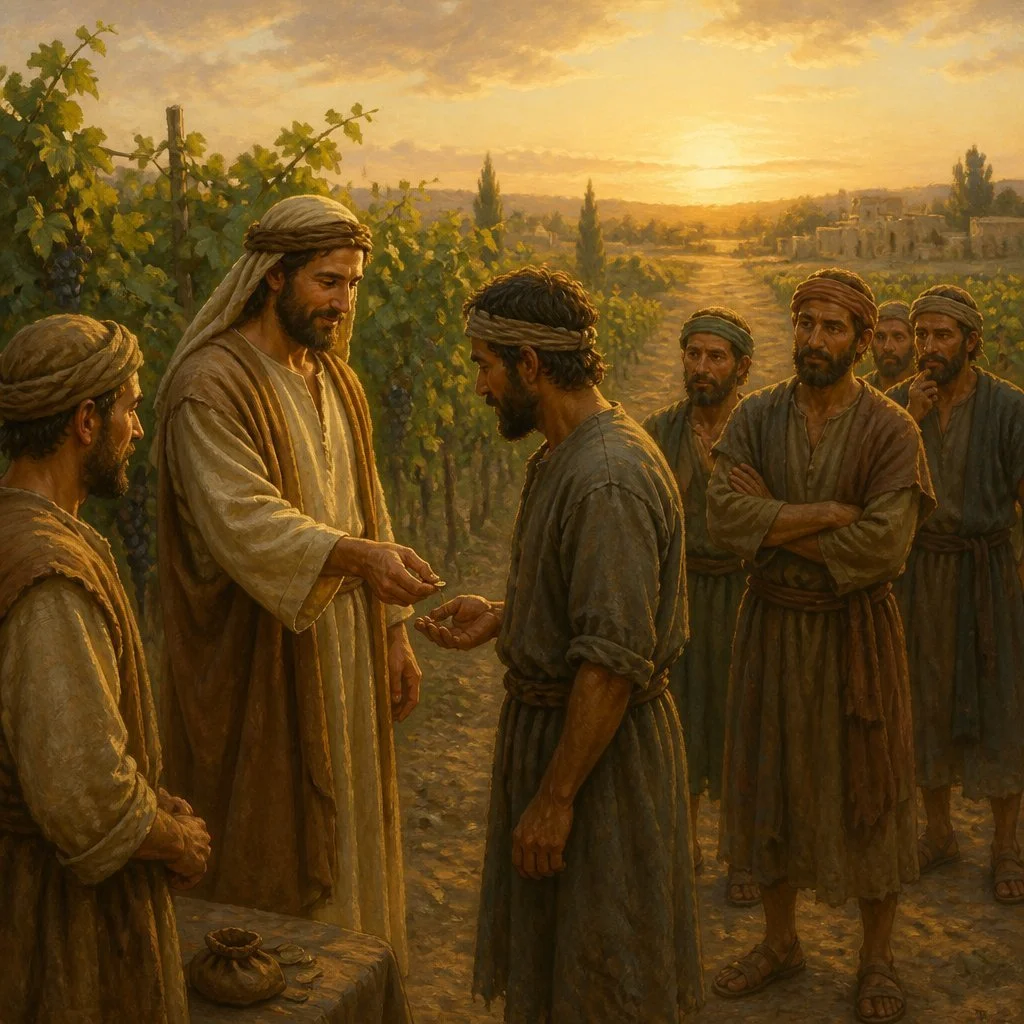
For me, the parable that we have read today the Parable of the Labourers in the Vineyard, another parable of Jesus that is found only in the Gospel attributed to Matthew, is one that can easily be read in a way that will lead us in the wrong direction.
If we look at the parable in one way, we may ask if it is talking about ingratitude and greed. If we focus only on the words of protest spoken by the laborers who were hired first thing in the day, those who had, “borne the burden of the day and the scorching heat” we might well think ingratitude and greed are the focus of the story. At the end of the day, when each worker, regardless of when they began to work, received the same amount of money, those workers hired early in the morning thought they would and should get paid more than the amount they had agreed on. And we should note that the amount they had agreed on was the usual daily wage. However, when the landowner paid that same agreed amount even to the other workers who had not “borne the burdens of the day and the scorching heat” – well, they were put out. They wanted more – after all, why should those who were hired at nine o’clock and at noon and at three and five get paid the same as them?
Or, if we approach this parable from another angle, we may think it is about a landowner who has a distorted morality or a warped sense of humour, a landowner gets a degree of weird pleasure in messing with and upsetting people. “I choose to give to this last the same as I give to you”, he said with a maniacal grin, asserting that he can do whatever he wants without regard to how those hired early in the morning might feel.
And then there are those last few words about the last being first and the first being last. Was Jesus really suggest that inequality or some other form of discrimination, unfairness or injustice are part and parcel of the kingdom of God?
Any of these pathways are easily entered into and walked along but, when followed, I think we end up far from the truth of the kingdom of God that Jesus was trying to express.
However, if we approach this parable seeking to discover the justice, equality, equity, inclusion and welcome of the kingdom, we may just come face to face with the truth Jesus is trying to convey.
In reading this passage time and again not only this past week but over the years, the words that stand out for me are the words the landowner spoke to those laborers who were hired and sent to the vineyard later in the day, those who were part of the second, third, fourth and fifth wave of workers. In his agreement with them about what they would be paid the landowner simply said, “I will pay you whatever is right”; no specific amount was mentioned, only whatever would be right.
The Greek word for “right” in the phrase, “I will pay you whatever is right” said by Jesus in this parable is “dikaios”. In its narrow sense “dikaios” can mean what you and I might immediately think and understand it to mean - nothing more and nothing less than “rendering to each their due.” In the context of this parable that would mean that if a labourer worked six hours they would get paid for six hours but if they worked only two hours, they would get paid only for two hours. However, if we limit our understanding of “dikaios” to this narrow sense of the word, I fear we end up in a bit of a quandary because by human understanding those hired second, third, fourth and fifth were certainly not due a full day’s wage – which is what we are told happened. In the narrow understanding of the word “dikaios” those hired later in the day should receive a pro-rated wage according to the percentage of the day they had actually worked in the vineyard. Only those hired first, those hired early in the morning, those who had worked the full day, those who had, “borne the burden of the day and the scorching heat”, were actually due a full day’s wage. And so, those hired first grumbled against the landowner because they thought that each worker should be paid only according to the hours they actually worked.
But the word “dikaios” has a deeper, richer meaning, a meaning that reflects the character and values of the kingdom of God. And in that Jesus himself prefaced this parable saying, “For the kingdom of heaven is like a landowner, … ” it is important that we take a good hard look; we should most certainly sit up, pay close attention and take notice.
In the phrase, “I will pay you whatever is right” said by Jesus in this parable, the word “dikaios” has a weightier meaning. In this parable doing what is right indicates a way of seeing, thinking, feeling, and acting that is wholly conformed to the will of God, as much as is humanly possible. In my understanding, that is the deeper, richer meaning of the landowner’s affirmation that he would do what is right. And as we heard last week, it is never wrong to do the right thing.
This parable, as do all the parables, shows us and teaches us that things in the kingdom of God challenge the way we human beings normally look at things. Some call it the great reversal of kingdom living but I would rather use the word alternative than reversal – this parable and indeed all the parables and all the teachings of Jesus show us an alternative, a divine alternative to our human way of seeing, thinking, feeling, and acting, an alternative that calls us to see, think, feel and act as does God, at least so far as is humanly possible. I am reminded of the words of Jesus that we heard just three weeks ago, words Jesus said to Peter, “You are setting your mind not on divine things but on earthly things.” (Matthew 16:23) Even St. Paul emphasised this kingdom alternative in his letter to the church in Colossae saying, “Set you mind on things that are above, not on things that are on earth.” (Colossians 3:2)
In the actions of the landowner in this parable today we see reflected the ways of God: in the kingdom, all are equally valued and loved by God; God does not pro-rate God’s gifts.
Some time ago I saw a frig magnet with a saying that read “God loves everybody … but I’m God’s favorite.” My bet is you could probably find it on a bumper sticker if you wanted to. Though that might be a cute little witticism, it is certainly rooted in human understanding not in divine understanding. In the kingdom there are no favorites, no teacher’s pets, no members preferred over others: God attaches the same value and gives the same unconditional love to each and every one of us regardless if we are the first in or the last to walk through the door.
And one final thought: it is interesting to me that this parable that we have read today come immediately after yet another exchange between Jesus and Peter. Just a few short verses before these that we have read today Peter, dear St. Peter, speaking apparently on behalf of all the disciples, said to Jesus, “Look, we have left everything and followed you. What then will we have?” Now maybe I might be reading too much into this but in reply I hear Jesus say to Peter that he and the other disciples will receive all the blessings of the kingdom of God … but so will everyone else who follows Jesus, everyone who’s seeing, thinking, feeling, and acting is wholly conformed to the will of God, bewildering the world around by doing the right thing, as the landowner in the parable today bewildered, I’m sure, all the labourers he had hired to work in his vineyard that day.